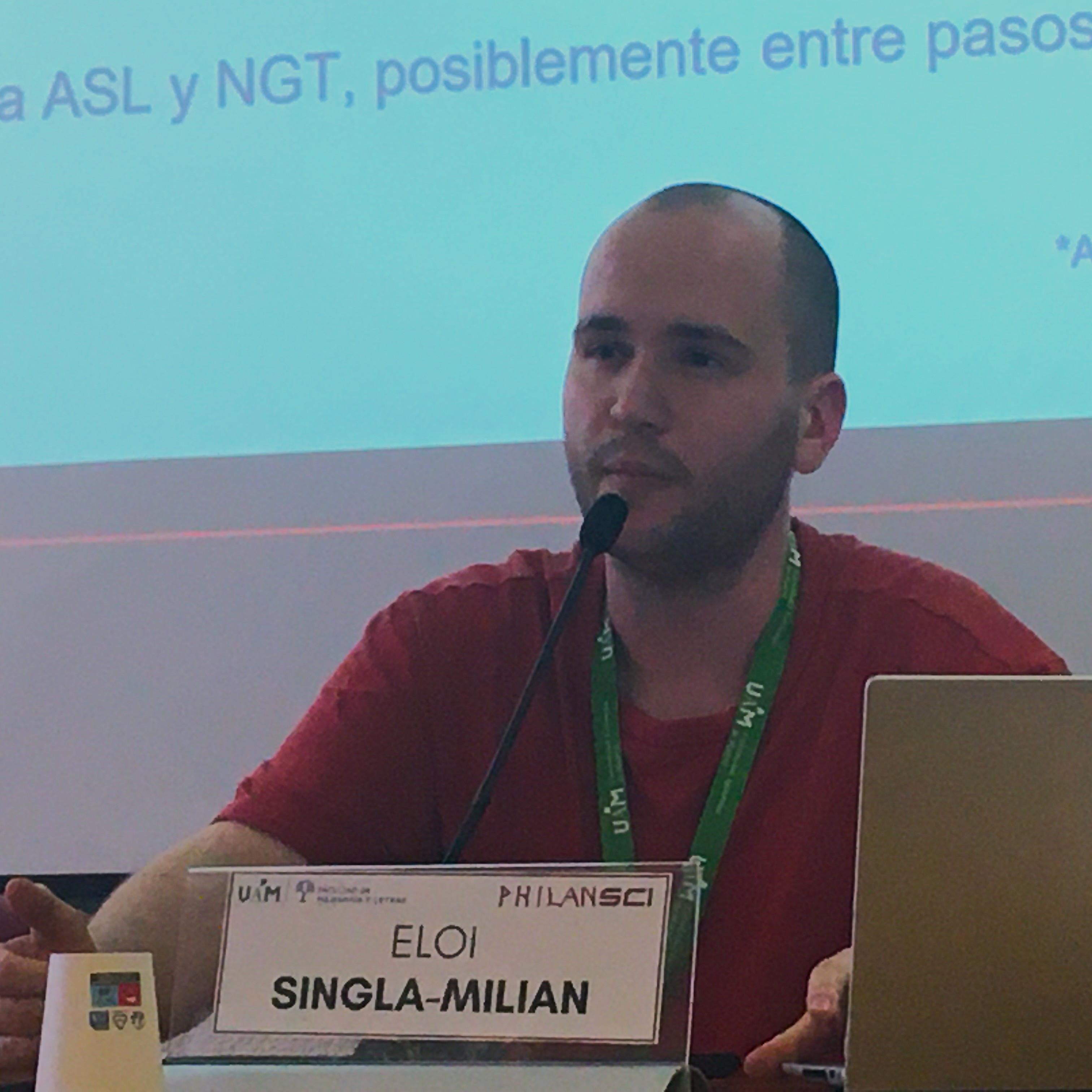
About me
I am a PhD candidate in Translation and Language Sciences at Universitat Pompeu Fabra. My work studies a construction in Catalan Sign Language (LSC) called Question-Answer Pair (QAP for short), how it behaves at different levels of language, and how it might vary for speakers of different ages.
My personal interest in linguistics is how formal theory and empirical research can inform each other. For me, theoretical questions should be grounded in solid data, and descriptive work becomes more meaningful when it connects to broader analytical frameworks. I am also committed to linguistic diversity and to working on minoritized languages such as Catalan, Scottish Gaelic, and Catalan Sign Language (LSC).
PhD project: Question–Answer Pairs in Catalan Sign Language
My doctoral research, supervised by Gemma Barberà and Laia Mayol, investigates question–answer pairs (QAPs) in Catalan Sign Language (LSC), a construction also present in many other sign languages. Traditionally they has been labeled as “rhetorical questions”, but their grammatical status remains debated in the sign language literature.
In this construction, a signer appears to produce a question and immediately provide the answer themselves. For example, the sentence below (in gloss) could be translated simply as “I live in Barcelona” or, possibly, as “Where I live is Barcelona”.
[IX1 LIVE WHERE]br, BARCELONA
The central issue is whether this pattern should be analyzed as a discourse-level sequence or as a single syntactic structure comparable to clefts or pseudoclefts in spoken languages. Research on American Sign Language, Sign Language of the Netherlands, and French Sign Language suggests that such constructions may follow a grammaticalization path, gradually shifting from question–answer sequences to more integrated cleft-like structures.
My project has three main objectives:
To formalize the syntax, semantics, and pragmatics of QAPs in LSC.
I examine whether they constitute a single clause, how they interact with presupposition and exhaustivity, and how they contribute to discourse structure.To determine whether QAPs exhibit microdiachronic variation across age groups.
I investigate whether there are generational differences in this structure that reveal ongoing change in the language.To situate LSC within the broader grammaticalization path described for other sign languages.
By comparing LSC to other languages, I will be able to contribute to wider debates on clefts, focus constructions, and the syntax–discourse interface.
Methodologically, the project integrates:
- Targeted elicitation sessions with native signers
- Manual corpus extraction and annotation
- Experimental testing with quantitative analysis
Beyond its theoretical contribution, this work aims to support the linguistic description of LSC, a language that remains comparatively understudied, and to foster dialogue between signed and spoken language research.
Beyond linguistics
Outside academia, one of my interests has always been music. I play different instruments, and perhaps the most uncommon among them is the organ, which I played at my town’s church for a good while. I also used to play bass in a punk band with some of my friends called TTC (Teo Trenca Cames), and we recorded an EP called “Terra Cremada” which is still on Spotify. Sadly I don’t play regularly anymore, but if you read this and want to jam sometime, let me know!
I’m also very interested in the academic study of religion, particularly in critical Bible studies. Eventually I’d like to learn Koine Greek and Biblical Hebrew so that I can read the primary sources directly, and maybe contribute to the field in some way.